
If you have ever slipped your feet into a pair of shoes and thought, “Something doesn’t feel right,” you’re not alone. I’ve been there too. Sometimes the length is perfect, the design is gorgeous, the brand is legit, but something still feels… off. Too tight. Too loose. Too cramped at the toes. Too roomy on the sides. And for the longest time, I didn’t know why. I thought maybe it was my feet being dramatic. Maybe I was wearing the wrong socks. Or maybe that particular shoe “just needed time.” Sound familiar?
It wasn’t until someone asked me, “Do you know what the B width means in shoes?” that I realized I had been shopping blind for years. B? Width? I didn’t even know shoes had letters. I was shocked. And honestly a bit embarrassed. I mean, I’m the person who collects shoes like someone collects stamps, and I didn’t know what shoes size B means. That day changed how I buy shoes forever. Suddenly, all my past discomfort made sense. That pair of beautiful loafers that squeezed my toes like they owed it money? Yeah, they were B width. My feet weren’t the problem. My ignorance was.
If you’ve ever wondered what B means in shoe sizes, or why some shoes feel tight even when the length fits perfectly, then you’re about to save yourself years of discomfort. Because once you understand shoe width, the whole world of footwear starts making sense. Shopping becomes easier. Wearing your shoes becomes more comfortable. And suddenly you stop wasting money on pairs that live under the bed. Width matters. A lot more than people think.
So, What Does B in Shoe Size Mean?
Let’s keep it simple.
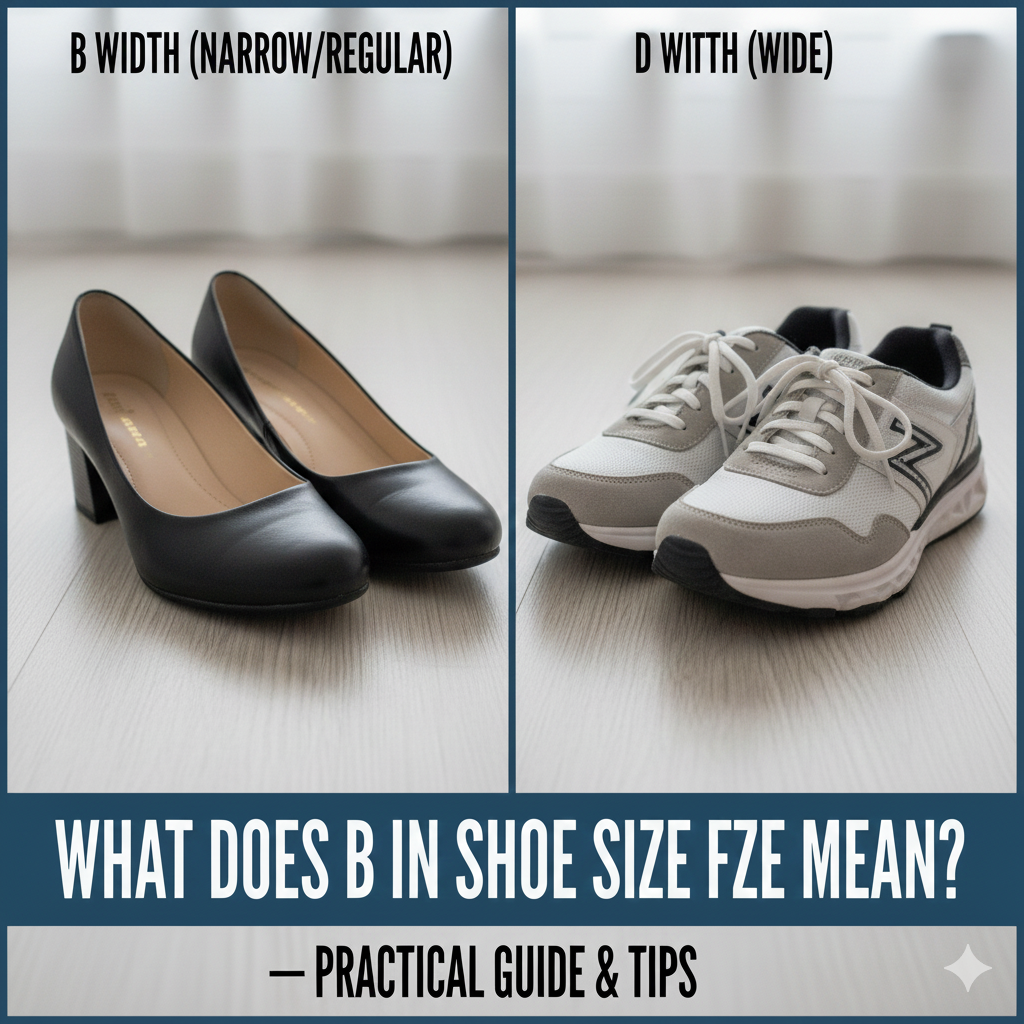
When you see the letter B on a shoe size, it refers to the width of the shoe, not the length.
In women’s shoes, B means “standard” or “medium” width.
In men’s shoes, B means “narrow” width.
That’s it. But the impact of that tiny letter? Massive.
A standard B width for women fits most average feet. Not too tight. Not too spacious. But if you have slightly wider feet, a B size may feel snug. For men, B width is slim and designed for narrow feet. So if you have wide or even slightly regular feet, a B width will feel tight for sure.
So anytime you see someone ask online “shoes size b means what?” you can tell them with confidence:
It means width. And not just any width — it means standard for women, narrow for men.
Why Shoe Width Matters More Than You Think
Here’s something I wish I knew early.
Length is only half of the story when it comes to shoe comfort.
Width decides everything else — balance, pressure, heel comfort, and toe freedom.
I once bought a pair of leather dress shoes that fit my length perfectly, but I couldn’t last ten minutes in them. My toes were fighting for their lives. My heel felt swallowed. The sides bulged out slightly. And the worst part? I forced myself to keep wearing them because I thought I was the problem, not the shoe.
Turns out the shoe was a B width. My feet? More like a D width.
No wonder they cried for help.
How to Know If B Width Is Right for You
Let’s break it down in the simplest way.
Use B width if you are:
- A woman with average width feet
- A man with narrow feet
- Someone whose feet don’t spill over the sides of the insole
- Someone who doesn’t feel pressure around the forefoot
Avoid B width if you:
- Have wide feet
- Have bunions
- Have high arches that push your foot outward
- Feel tightness in the midfoot area
- Notice red marks after wearing shoes
If you’re unsure whether yours is a narrow, regular, or wide foot, I’ll show you how to measure it later in this post.
How to Measure Your Shoe Width at Home (Easy Method)
You don’t need a fancy machine or a professional footprint scanner.
Just do this:
Step 1: Place your foot on a sheet of paper
Yes, barefoot. Socks add thickness.
Step 2: Trace around your foot
Try not to move your toes.
Step 3: Use a ruler to measure the widest part
Usually across the ball of the foot.
Step 4: Compare with a width chart
Here’s a quick guide for women:
- B width: 3.2 to 3.55 inches
- D width: 3.6 to 4 inches
And for men:
- B width: 3 to 3.5 inches
- D width: 3.5 to 4.25 inches
If your measurement fits into the B range, then shoes size B means your perfect match.
If not, you need something wider.
Why Some Shoes Feel Tight Even When They Are B Width
This is where it gets interesting. Shoes are not all shaped the same way.
Two B width shoes from two brands might feel different.
Why?
Because:
- Some brands cut their shoes slimmer
- Leather stretches differently
- Synthetic shoes don’t stretch at all
- Toe boxes vary in shape
- Heels can be narrow or rounded
For example:
- Pointed toe shoes feel tighter even in B width
- Round toe shoes feel more relaxed
- Sneakers tend to run wider
- Dress shoes often run narrower
So if you slip into a pair of shoes and feel discomfort, don’t blame your foot immediately. Sometimes the shoe itself has a personality.
Common Shoe Width Letters and What They Mean
Since you’re already learning about B width, it’s helpful to know the other letters too:
Women’s Shoe Widths:
- AA or 2A – narrow
- A – slightly narrow
- B – medium
- C/D – wide
- E – extra wide
- EE – ultra wide
Men’s Shoe Widths:
- A/B – narrow
- C/D – medium
- E/EE – wide
- EEE – extra wide
This is why shoes size B means different things depending on gender.
How to Tell if Your Current Shoes Are the Wrong Width
Here’s a little checklist that has saved many feet.
If you notice at least two of these signs, you might be wearing the wrong width.
- Your toes feel squeezed
- The sides of the shoes leave marks on your feet
- Your big toe leans inward
- Your heel slips out while walking
- Your feet go numb after a few minutes
- You feel burning under the ball of your foot
I used to think numb toes meant “the shoe just needs breaking in.”
No. Numb toes mean “your shoe is trying to kill you slowly.”
Real-Life Scenario You Might Relate To
A friend of mine once bought a beautiful pair of suede pumps. She swore the shoes would behave after a few wears. She used all the tricks — thick socks, walking around the house, stretching spray. But every time she wore them out, her little toe peeped through the cutout like it was trying to escape prison.
I took one look at the shoe and said, “These are B width. Your feet are D width. The shoes are innocent. Your width is the real issue.”
We laughed, she sighed, and she finally bought a wide version. Guess what?
She walks like a queen now.
How To Choose the Right Shoe Width When Shopping Online
Buying shoes online is risky if you don’t know your width.
But here’s how to do it right:
- Always check the width chart
- Look for customer reviews mentioning width
- Choose brands that include width letters
- Stick to round toe shapes if you have doubts
- Buy from stores with free returns
Online shoe shopping becomes easier once you understand what shoes size B means and whether your foot matches that width.
What Happens If You Wear B Width Shoes When You Shouldn’t?
This is where problems start.
Bad width choices can cause:
- Corns
- Bunions
- Blisters
- Toe deformities
- Arch pain
- Back pain
- Shoe imbalance
Shoes affect more than feet.
They affect posture and even your walking confidence.
No one likes walking funny because their shoes fight them.
Can You Stretch a B Width Shoe?
Yes, but only to an extent.
Leather can stretch.
Suede can stretch.
Fabric shoes? Almost no stretch at all.
If your feet are slightly wide, a B width leather shoe might still work with:
- Stretching spray
- Shoe stretchers
- Professional shoe stretching
But if your feet are truly wide, no amount of stretching will make a B width feel like a D width.
FAQ
1. Shoes size B means what exactly?
It means the width of the shoe. Standard for women, narrow for men.
2. Can men wear B width shoes?
Yes, if they have genuinely narrow feet.
3. Is B width tight?
It is only tight if your feet are wide. Otherwise it’s the normal width for women.
4. Should I size up if a shoe is B width?
No. Length and width are separate. Size up only changes length, not width.
Final Thoughts
Your feet carry you all day, every day. They deserve shoes that fit comfortably. Now that you know what shoes size B means, shopping becomes easier. You’ll be able to tell instantly whether a shoe is right for you or not. And you’ll save money, save time, and save your toes from unnecessary suffering. So the next time you pick up a shoe and see a little letter beside the size, think about your feet with kindness. After all, don’t you want every step you take to feel good?
Which type of shoe width do your feet usually prefer?
